Sharpening the Instrument

As someone who drives a lot, I wonder how I’d live without podcasts. Podcasts have fast become a primary source for entertainment, knowledge, and connection. Especially on work days, podcasts are my constant companions and they set my attitudinal compass for the day. If I wake up feeling haggard and need to laugh, I look to Joe Rogan. If I’m flying high from a week of good running, I listen to Billy Yang and marvel at stories of 100-mile races and the athletes who win them. If I’m seeking professional wisdom and strategies to enhance my life, Tim Ferris delivers every time.

In a given month, my podcast diet frames how I view the world and my place in it. Sometimes, podcast conversations hit with such impact, they change my life fundamentally. Which brings me to Roger McNamee, Tristan Harris, and Cal Newport. McNamee wrote “Zucked” about his early investment in Facebook and subsequent disillusionment with social media, Harris worked as a Google Design Ethicist and gained fame for his TED talk and “60 Minutes” interview, and Newport authored the best-selling “Deep Work” based on his career as a computer scientist. For more background than I can write here, I recommend searching available conversations with these thinkers on Apple podcasts, Overcast, or other sources. Though they come from different professions and perspectives, each man has sounded an alarm about the attention economy and our changing inner lives.

McNamee, Harris, and Newport argue while social media, smart phones, and other ubiquitous digital tools can be helpful, these tech advances have also shortened our attention spans, stifled creativity, and created a tech-addicted society. Though many news stories, research articles, and other media have echoed these ideas, McNamee, Harris, and Newport bring uniquely insider viewpoints and credibility. Their podcast conversations opened my eyes to my own tech addiction and to society’s challenging relationship with screens.

With the above concepts swirling in my head, I’ve wondered how to react. I’m not a conspiracy theorist and intellectual rabbit holes can be a serious downer. If the digital world is murky, I’d rather focus on something healthier and not get stuck in the mire. Fortunately, Cal Newport has offered a solution and a path forward.

Deep work is focused, thoughtful work, free of distraction. It’s work that proceeds uninterrupted, without checking Facebook, answering emails, or grabbing a pinging smart phone. Deep work also seems like something many of us haven’t done in quite a while.

Newport explains how we’ve “lost our way” as thinkers and creators. Before the addictiveness of smart phones and social media, people used to sit and reflect. We dealt with boredom by letting our thoughts wander until something interesting or meaningful popped up. Now, at the first sign of boredom, we reach for our phones. Once on our phones, laptops, or tablets, we toggle between websites and apps, never quite finishing an article or pausing to think or look around. As many have felt intuitively, it seems we just can’t concentrate anymore. “Deep Work” argues not only can we regain our attention through deep work, we can actually benefit creatively and professionally.

I began reading “Deep Work” and actualizing my return to focus a few weeks ago. I long ago deleted Facebook from my phone and I didn’t use Instagram or Twitter on any device. Even so, I still felt deeply distracted. So, I set a 15-minute daily Facebook limit. Some people deleted Facebook altogether, but 15-minutes/day seemed like a good start.

I recently returned to a more regular writing practice and I’m now pursuing a daily writing routine. I’ve also shifted my habits from expressing myself on social media to writing my thoughts on this blog. Long-form blogging takes time, introspection, analysis, editing, and deep work, all things I find missing on social media. Fewer people may read the conversation, but it will definitely be a richer, more fulfilling process for all involved.

As I mentioned in my first post here, I started a blog to build connections and share ideas with others. I wanted to pursue deep work, though I didn’t have a name for it, yet. I encourage everyone to seek out Roger McNamee, Tristan Harris, Cal Newport, and their podcast conversations and books, especially “Deep Work”. The dangers of our digitally-addicted world can seem daunting and frightening. Maybe we’d be happier and more connected if we visited that world less and spent more time creating the lives we want to live.
Closing the Loop

In a typical work week, I spend much of my time “closing loops”, “circling back”, and “completing circles”. Functionally, this means I follow up on pending tasks and ensure their completion. Bringing jobs over the finish line builds goodwill with customers and creates a sense of workplace harmony and balance. As a bonus, the customer’s happy and I feel self-actualized and relieved.

If a simple task is completed in one or two days, I feel I’m achieving professional excellence. If it takes a week or two, I know I’ve succeeded with, maybe, a slight sense of flakiness. After a month, I start to feel like a plumber plugging a leak in a house submerged in water. Though a path to completion exists, success looks distant and I wonder if the whole thing should be scrapped.

In life, there’s something about the trajectory of unease that accompanies unfinished work. With time, the unease morphs into mental clutter. Sometimes, mental clutter overlaps physical clutter or vice versa, resulting in anxiety and inertia. With even more time, negative feelings compound. We see evidence of this in the soaring popularity of Marie Kondo and the “tidying” trend. Watching Kondo work her magic reminds us how great we feel when we finish long-standing to-dos. We realize how any unfinished business manifests emotionally and spiritually. And, when we finish and let go, we often wonder what took us so long.

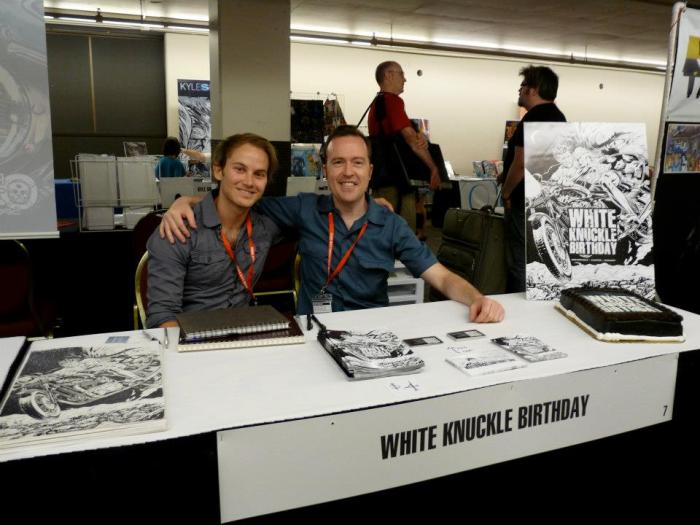
Last month, I began closing one of the widest, longest loops of my life. I delivered a “damn-near final” draft of “White Knuckle Birthday” (WKB), a comic I began writing in 2009. Though a few dialogue edits remain, the script is essentially done. The artwork looks exceptional and the project has picked up tremendous momentum. It appears we may even publish our graphic novel by year’s end.

While I’m incredibly thankful and excited for the end product, the personal growth and mental shift are also immeasurable. Even if work balloons way over budget and takes 5 times as long as planned, when it’s done, everything else falls away. One may feel like a schmuck while status updates continually reveal a glaring productivity vacuum, but it doesn’t matter. It will hurt for only a little while. Even if the little while becomes a long while. Finishing will bring freedom. The freedom to assess what was learned, what went well, and what might go better next time. Looking back, the waiting was painful, but the end product and sense of self-actualization will linger long after the delay is forgotten.

Process

Outcomes are slippery creatures. In practical terms, considering outcomes helps shape our daily lives as we track goals or pursue passions. We may wrap hard work or boring tasks around the idea it’s all worth it because an outcome will make it so. And, experience often tells us this is correct.

Yet, outcomes are inevitably different than we envision. Just as we lack the power to predict the future, we will never know precisely how something will play out. A wise friend once told me, “be careful worrying about outcomes.” I was in my mid-twenties at the time and his words were a revelation. I reflected on major life events and realized none of them unfolded as I’d expected. I’ve carried this concept with me as something of a mantra ever since. Of course, releasing ourselves from outcomes helps us focus on only the present; a fundamental mindfulness practice.

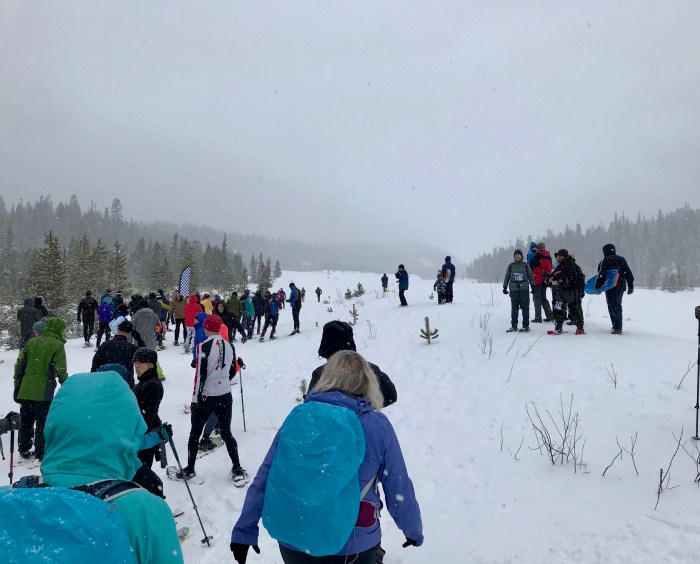
I considered these ideas today as I wondered if I might take a header into a tree well. I’d signed up for my first “snowshoe race” and discovered just how tired legs can feel after slogging through snow on state-of-the-art tennis rackets. The race arrived a week after having a diagnosed case of Influenza A and five-day courses of Tamiflu and Prednisone, so, again, “outcomes”.

I’d been excited about the snowshoe race since I first heard about it last summer. After running hard every week of 2018, the White River 4K Snowshoe Race seemed the perfect test of my training. So, I bought special “running snowshoes” and planned to break them in two weeks before the race. Then, the night before my planned trial, the flu hit.

So, I sat in bed for four days and considered outcomes. I took ten days off (my longest break in a year) and returned to running less than a week prior to the race. I felt weak and lacked the energy reserves I typically had when running. But, after a few days back, I decided I would race, even if it ended in disaster.

I arrived at the race with a few simple goals: to finish, to not stop or walk, and to have fun. The strange thing about running is having fun often coincides with feeling like you’re going to vomit. As such, I had a lot of fun today. I felt weaker than usual, but it didn’t matter. The beauty of running, the true essence, derives from the process. There’s something about flailing through the forest while snow and sweat soak your clothes that feels like the truest freedom. Past and future dissolve to reveal a moment when the only thing that matters is you’re a kid again.


True North

I’ve always had a passion for writing and storytelling. At times, that passion evolved into a daily commitment and serious dedication to writing craft. Other times, the passion gathered dust as life hurtled forward. Over the years, I got close to Malcolm Gladwell’s hallowed 10,000 hours, but stopped a few thousand shy. Yet, no matter how long I stayed away, writing remained my True North. The discipline through which I found grounding, direction, clarity, and growth.

A lot has changed since I originally sought to be a professional writer: grad school, a career change, marriage, fatherhood, and a significant increase in responsibilities. Still, the craft remains, as does the hunger for transformation and the curiosity to learn more.

I considered several approaches to this blog venture: creative writing only, political commentary, “daddy blog”, Metal blog – all of the above combined? Ultimately, I decided my blog should create a venue for positive connections. All other discussions would wrap around that central idea.

While social media offers constant interconnectedness and instant dopamine hits, I’d love to slow down and live more. I want my blog to reflect that. I aim to make this site a place to explore deeper truths and celebrate life through writing. Also, I hope this site is incredibly funny. I look forward to connecting with friends and family, and even people I don’t know, yet. With a little luck, some of those people will like Metal. I appreciate you stopping by and hope to hear from you down the road.

Arrival

Welcome to my online home and blog. I look forward to using this platform to connect, share ideas, and dialogue. I hope you make this site as much your home as it is mine.

“The world always seems brighter when you’ve just made something that wasn’t there before.” – Neil Gaiman